
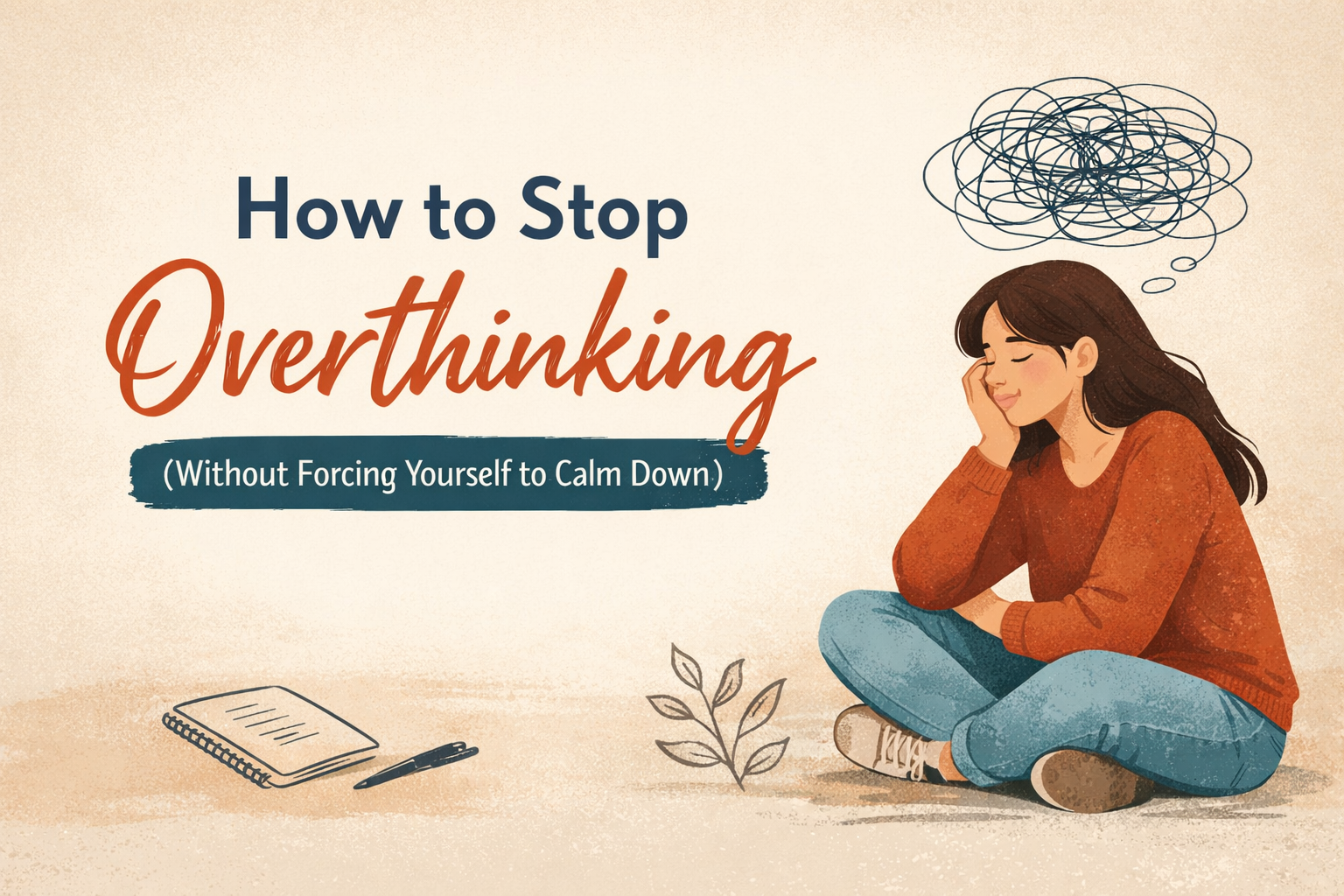
You know that moment…
When one small conversation keeps replaying in your head.
You start analyzing your tone… their tone… what they meant… what you should have said instead.
And before you realize it, you’re stuck in a loop that just won’t stop.
You tell yourself,
“Just stop overthinking.”
But your mind doesn’t listen.
If anything, it goes deeper.
If you’re searching for how to stop overthinking, I want you to hear this first:
You’re not overthinking because you’re weak.
You’re overthinking because your mind is trying to protect you.
What Is Overthinking? (And Why It Happens)
Most people think overthinking means thinking too much.
But that’s not completely true.
Overthinking is the need to control something that feels uncertain.
- Replaying the past → trying to fix what already happened
- Worrying about the future → trying to predict outcomes
- Overanalyzing people → trying to avoid rejection
Your brain believes:
“If I think enough, I’ll find an answer… and then I’ll feel calm.”
But instead, you feel more anxious.
That’s why understanding this is the first step in learning how to stop overthinking.
Why You Can’t Just Stop Overthinking
If it was that easy, you would have already stopped.
The problem is not your effort.
The problem is your brain’s design.
Your mind sees uncertainty as a threat.
So it keeps thinking, looping, analyzing—trying to “solve” the discomfort.
But here’s the truth:
Not everything can be solved.
You cannot fully control:
- What others think about you
- How situations will turn out
- Whether things will go your way
And yet your mind keeps trying.
That’s exactly why overthinking doesn’t stop.
The Real Shift: Stop Trying to Control Everything
Most advice on how to stop overthinking tells you to control your thoughts.
But that often makes things worse.
Because now you’re thinking about your thinking.
The real shift is this:
You stop overthinking when you stop trying to control everything.
This doesn’t mean you stop caring.
It means you accept:
- “I don’t know what they meant—and that’s okay.”
- “I don’t know what will happen—and I can handle it.”
This is not weakness.
This is emotional strength.
How to Stop Overthinking (Simple, Practical Steps)
If you’re wondering how to stop overthinking in daily life, start with these small shifts:
1. Ask: What am I trying to control right now?
This question brings instant clarity.
Most of the time, you’re trying to control:
- Someone’s opinion
- A future outcome
- A past mistake
Once you see it, the intensity reduces.
2. Separate Action vs Imagination
Ask yourself:
“Is there something I can do right now?”
- If yes → take action
- If no → it’s just mental looping
And looping doesn’t need solving.
3. Set a Time to Think
Instead of forcing your thoughts to stop, try this:
“I’ll think about this tomorrow at 2 PM”
It sounds simple, but it tells your brain:
“Not now.”
And slowly, your mind learns to pause.
It’s a powerful step when learning how to stop overthinking at night.
4. Move Your Body
Overthinking is not just mental—it’s physical.
Go for a walk. Stretch. Clean something.
Movement helps release stuck mental energy.
5. Accept Uncertainty (Gently)
You don’t need all the answers right now.
Tell yourself:
“I don’t know yet—and that’s okay.”
This reduces the pressure your mind is trying to escape.
A Truth Most People Don’t Realize
Peace doesn’t come from solving everything.
It comes from not needing to.
You don’t need to figure out every situation to feel calm.
You just need to stop treating every thought like a problem.
That’s the real secret behind how to stop overthinking.
Sometimes Overthinking Is Actually Emotional Attachment
Sometimes, overthinking is not just about thoughts.
It’s about emotional dependence.
The need for reassurance.
The need for clarity.
The need to feel chosen.
If you often:
- Get attached quickly
- Feel affected by someone’s behavior deeply
- Overanalyze relationships
Then your overthinking may be rooted in that.
You can explore this deeper here:
👉 Why You Get Attached Too Fast (One-Sided)
Final Thought: You Don’t Need to Fight Your Mind
The next time your thoughts start spiraling…
Don’t force yourself to calm down.
Just pause and ask:
“What am I trying to control right now?”
And gently remind yourself:
“Maybe I don’t need to control this.”
That’s where overthinking starts losing its grip.